

Blog

What Are PU Sandwich Panels and How Do They Work?

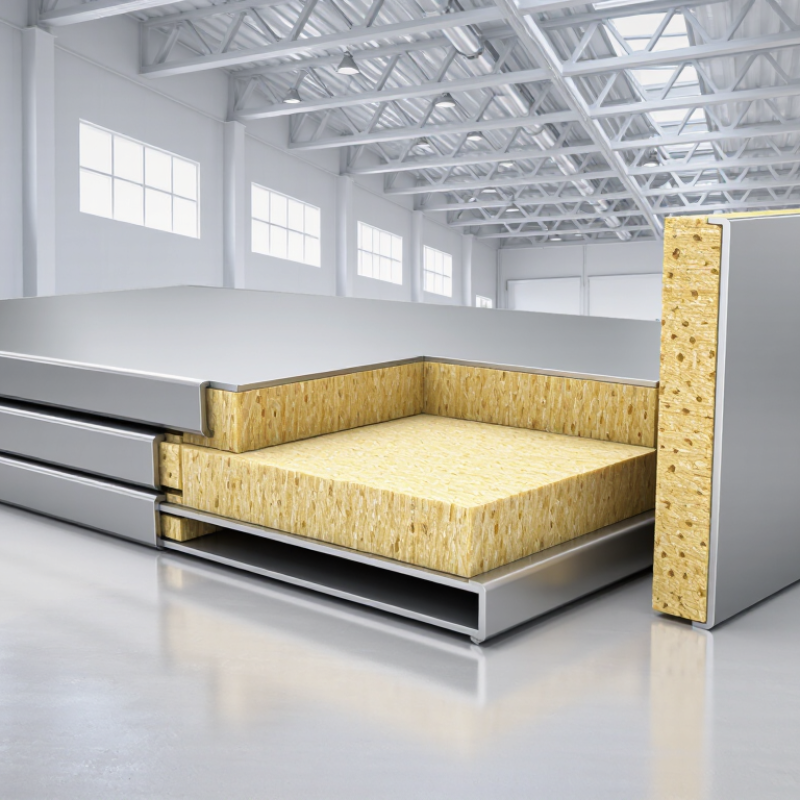
PU sandwich panels are engineered building elements with a rigid polyurethane core between two protective facings. They are used in cold rooms, warehouses, factories, and controlled industrial spaces. The core supplies insulation, while the outer sheets provide strength, impact resistance, and surface protection. In practical terms, one panel combines several construction functions.

Dr. Michael Thielen, a recognized polyurethane materials specialist, describes polyurethane as “one of the most versatile plastics in the world.” That versatility explains why PU sandwich panels remain popular in temperature-sensitive buildings. During production, chemical components react and expand between the facings. The resulting closed-cell foam traps tiny pockets of gas, slowing heat transfer through the panel. It feels simple, but the performance depends on density, thickness, joint design, and installation quality.

A tight joint matters.

If panels are cut poorly, thermal bridges and air leakage can reduce the expected efficiency. Moisture can also enter through damaged edges or neglected seals. Fire performance requires careful attention to the complete system, not only the foam core. This is where simplified product claims become less useful. A panel may offer excellent insulation, yet perform poorly when exposed to unsuitable temperatures, water, mechanical abuse, or careless fastening.

This article explains how PU sandwich panels work, what materials they contain, and why their layered structure is effective. It also examines practical limitations, installation details, and selection factors. The goal is not to present them as perfect products. It is to show where their advantages are dependable, and where thoughtful design remains necessary.
What Are PU Sandwich Panels and How Do They Work?

Definition and Core Structure of PU Sandwich Panels

A PU sandwich panel is a factory-made building element with three bonded layers. Its core contains rigid polyurethane foam, usually called PUR. Two protective facings surround it, commonly coated steel or aluminium. The core supplies insulation, while the facings provide stiffness, impact resistance, and surface protection.

The structure is simple, but its performance depends on precise bonding. During production, liquid chemical components expand and cure between the facings. This creates a continuous foam layer with small, closed cells. Those cells slow heat transfer and reduce air movement inside the core. According to the 2023 Buildings Global Status Report by UNEP and GlobalABC, buildings consume about 30% of global final energy and create 26% of energy-related emissions. Better envelope insulation can address part of that burden.

The panels also work as lightweight composite elements. The outer sheets resist bending forces, while the foam helps maintain spacing between them. Joints, fasteners, and edge details remain critical. A perfect factory panel can lose practical value when installation leaves gaps. This is often overlooked. EN 14509 specifies performance requirements for factory-made, double-skin metal-faced insulating panels, including thermal and mechanical considerations. Designers should also distinguish PUR from PIR, because their fire and thermal characteristics are not identical. Moisture, damaged coatings, and poorly sealed joints may reduce service performance over time.

What Are PU Sandwich Panels and How Do They Work?

PU sandwich panels consist of two thin, rigid facings bonded to a lightweight polyurethane foam core. The facings provide mechanical protection and load distribution, while the closed-cell PU core reduces heat transfer and adds stiffness without significantly increasing weight.

Typical thermal conductivity of insulation cores: Lower values indicate better insulation performance. Polyurethane foam commonly achieves about 0.022–0.028 W/m·K, making it an effective core material for insulated wall, roof, and cold-storage panels.

Materials and Manufacturing Process

What Are PU Sandwich Panels and How Do They Work?

PU sandwich panels combine two protective facings with a rigid polyurethane (PU) insulation core. Steel or aluminum sheets provide structural protection, while the PU layer limits heat transfer. Their performance depends on core density, panel thickness, joint design, and installation quality.

The manufacturing process starts with measured polyol and isocyanate components. They react quickly and expand through a controlled blowing agent. The liquid mixture is placed between moving metal facings on a continuous production line. Pressure rollers maintain thickness while the foam cures. Cutting follows after the panel reaches stable strength. EN 14509 identifies key requirements for metal-faced sandwich panels, including thermal performance and dimensional tolerances. Typical PU core conductivity can range from about 0.020 to 0.028 W/m·K, depending on formulation and testing conditions. Values vary more than many brochures suggest.

The International Energy Agency’s 2023 Global Status Report for Buildings and Construction states that buildings consume about 30% of global final energy. This explains the appeal of efficient envelope materials, but insulation alone cannot fix poor detailing. Thermal bridges, open joints, and damaged facings can reduce real-world results. The material is efficient. Installation remains the weak link.

Tips: Check declared thermal conductivity, fire classification, joint tolerances, and moisture resistance. Ask for tested data, not only calculated values. Review the installation drawings before ordering. That step is often skipped.

What Are PU Sandwich Panels and How Do They Work? — Materials and Manufacturing Process
Data Dimension Typical Material or Value Technical Description and Function
Basic Construction Two rigid facings with a polyurethane foam core The facings protect the core and provide tensile and bending support, while the foam core separates the skins and contributes insulation and shear strength.
Core Material Rigid polyurethane foam, commonly abbreviated as PU or PUR The closed-cell foam contains gas-filled cells that reduce heat transfer and provide a lightweight structural core.
Common Facing Materials Pre-painted or galvanized steel, aluminum, stainless steel, plywood, or cement-based sheets The facing is selected according to corrosion resistance, appearance, hygiene, impact resistance, fire requirements, and structural loading.
Main Chemical Components Polyol blend, isocyanate, blowing agent, catalysts, surfactants, and selected additives Polyol and isocyanate react to form polyurethane. Catalysts control reaction speed, surfactants stabilize the cellular structure, and blowing agents create the foam cells.
Foam-Forming Reaction Exothermic polymerization and gas generation When the liquid components are mixed, they react, expand, and cure. The expanding foam bonds to the facings and fills the panel cavity.
Cell Structure Predominantly closed-cell structure Closed cells limit moisture movement and air circulation through the core, supporting low thermal conductivity and good dimensional stability.
Typical Core Density Approximately 35–45 kg/m³ for many building panels Actual density depends on the product design, thickness, production method, and required mechanical or thermal performance.
Thermal Conductivity Approximately 0.020–0.028 W/(m·K) for the foam core Lower values indicate better insulation. The declared performance of a finished panel also depends on joints, facings, aging, temperature, and moisture conditions.
Typical Panel Thickness Commonly about 30–200 mm Thicker panels generally provide greater thermal resistance. The appropriate thickness is determined by climate, indoor conditions, energy targets, and building regulations.
Approximate Thermal Resistance About 1.8–8.0 m²·K/W for 40–200 mm of foam, before allowance for joints and surface effects A simplified estimate uses R ≈ thickness ÷ thermal conductivity. The calculated value should not replace a certified declared or design value.
Manufacturing Method: Continuous Line Continuous double-belt or laminating production Coils are unwound, profiled or coated, the chemical mixture is deposited, and the expanding assembly passes through a controlled press before cutting to length.
Manufacturing Method: Discontinuous Press Batch panel production in a heated or controlled press Pre-cut facings are assembled with reacting polyurethane, placed in a mold or press, and held until the core reaches sufficient cure and dimensional stability.
Key Production Steps Facing preparation → component metering → mixing → foaming → pressing → curing → trimming → inspection Accurate metering, uniform mixing, controlled temperature, correct press pressure, and adequate curing are essential for consistent bonding and thickness.
Adhesion Mechanism Chemical and mechanical bonding between foam and facings The reacting polyurethane wets the facing surface and develops adhesion as it expands and cures. Surface cleanliness and compatibility strongly affect bond quality.
How Heat Transfer Is Reduced Low-conductivity gas-filled cells and limited internal convection The fine closed-cell structure interrupts solid conduction and air movement, while the panel thickness increases the length of the heat-flow path.
Structural Behavior Composite, stressed-skin action The facings carry much of the tensile and compressive bending stress, and the bonded foam core transfers shear while stabilizing the skins against buckling.
Moisture Performance Generally low water absorption compared with open-cell insulation The closed-cell core resists liquid water penetration, but panel joints, cut edges, fasteners, damaged coatings, and condensation must still be properly detailed.
Air and Vapor Control Dependent on facings, joint design, seals, and installation quality A panel core alone does not guarantee an airtight or vapor-tight enclosure. Seams, penetrations, corners, and connections require compatible sealing systems.
Dimensional Stability Good when properly manufactured and installed; affected by temperature and aging Thermal cycling, long-term foam aging, differential movement between facings, and inadequate support can influence flatness and joint performance.
Fire Performance Product-specific; must be verified by the applicable fire classification or test report Polyurethane is an organic polymer and can contribute fuel when exposed to fire. Performance depends on formulation, facing type, thickness, joints, and the complete assembly.
Typical Applications Cold rooms, refrigerated buildings, warehouses, factories, roofs, walls, and controlled-environment spaces Applications are selected for rapid enclosure, thermal insulation, hygienic surfaces, lightweight construction, and reduced on-site installation time.
Installation Requirements Aligned supports, appropriate fasteners, sealed joints, protected cut edges, and controlled tolerances Correct installation prevents thermal bridging, air leakage, water ingress, panel damage, and excessive stress at connections.
Advantages High insulation efficiency, low weight, factory-controlled quality, and fast installation The integrated composite design can reduce wall or roof thickness compared with some lower-performance insulation systems while providing a finished surface.
Limitations Fire-design constraints, facing damage risk, joint sensitivity, and limited tolerance for poor detailing Performance depends on the complete panel assembly. Improper cutting, unsupported spans, incompatible sealants, or unprotected edges can reduce service life.
Quality-Control Checks Dimensions, density, thickness, flatness, facing condition, bond strength, thermal properties, and visual defects Testing and inspection help confirm that the finished panels meet specified manufacturing tolerances and declared performance requirements.
End-of-Life Consideration Reuse, material separation, recovery, or regulated disposal where available The bonded composite structure can make separation more difficult. End-of-life options depend on local facilities, panel condition, facing materials, and applicable regulations.

Note: Values are representative ranges for general technical reference. Final selection should be based on project-specific product declarations, test standards, structural calculations, fire requirements, and building codes.

How PU Sandwich Panels Provide Thermal Insulation

What Are PU Sandwich Panels and How Do They Work?

PU sandwich panels combine two rigid outer sheets with a polyurethane foam core. The core contains millions of tiny closed cells. These cells trap low-conductivity gas and restrict heat movement. The panel works like a continuous thermal barrier.

Thermal insulation is the main advantage. Typical polyurethane cores can achieve declared thermal conductivity values near 0.022–0.028 W/m·K, depending on density, formulation, and testing conditions. Under EN 13165 testing principles, lower conductivity generally means better insulation. A 100 mm panel may therefore provide substantial resistance without consuming much interior space. This matters in cold stores, workshops, and industrial roofs.

The details decide the result. Tight joints reduce air leakage, while sealed edges help limit moisture entry. A damaged facing can create a local weak point. Real sites are messier. Poor alignment, metal bridges, and unsealed fasteners may reduce the measured performance.

The 2023 UNEP Global Status Report for Buildings and Construction states that buildings use about 30% of global final energy and produce roughly 26% of energy-related emissions. Better insulation can reduce heating and cooling demand, but panels are not magic. Designers still need climate data, condensation checks, fire performance verification, and proper installation records.

Field inspection matters. A small gap can become a large heat-loss path.

Key Performance Features and Practical Applications

What Are PU Sandwich Panels and How Do They Work?

PU sandwich panels use a rigid polyurethane foam core between two protective facings. The core limits heat movement, while the facings provide stiffness and surface protection. Many panels achieve thermal conductivity near 0.022–0.028 W/m·K, depending on density, thickness, moisture, and aging.

Their strongest feature is insulation efficiency. The IEA’s 2023 Global Status Report for Buildings and Construction states that buildings consume about 30% of global final energy. Better envelope performance can reduce heating and cooling demand, although installation quality matters just as much. Poorly sealed joints create cold bridges. Small gaps can produce condensation, odors, and hidden corrosion. I have seen impressive laboratory values weakened by careless site work. That is an uncomfortable detail, but it matters.

PU panels suit cold rooms, food-processing areas, warehouses, clean production spaces, and modular buildings. They install quickly and reduce wall thickness compared with many traditional insulation systems. However, fire performance depends on the complete assembly, not the foam alone. Designers should check tested classifications, panel joints, fixings, and local requirements. EN 14509 offers a recognized framework for factory-made insulated panels, while ASHRAE guidance supports careful heat-flow and moisture analysis.

Tips: Specify the required U-value, not only panel thickness. Inspect every joint and penetration. Confirm fire, hygiene, and moisture data before installation. Recheck performance after years of service; real buildings are rarely perfect.

Installation Methods, Maintenance, and Safety Considerations

PU sandwich panels combine two strong outer sheets with a polyurethane insulation core. They are lightweight, rigid, and effective at reducing heat transfer. During installation, workers should check the wall or roof frame for level, spacing, and corrosion. Uneven supports can create gaps and stress. Panels are usually positioned from a fixed corner, then secured with suitable fasteners and sealing washers. Joints need continuous gaskets or approved sealant. Small gaps matter.

Cutting requires a fine-tooth saw and careful measurement. Exposed insulation should not remain open to weather, moisture, or heat sources. Workers should avoid dragging panels across concrete because damaged edges may compromise the joint. In practice, rushing this step causes avoidable repairs. I have found that a dry fitting check often prevents misaligned panels.

Maintenance should include regular inspections of fasteners, seals, flashings, and surface damage. Look for water stains, loose screws, dents, and separated joints. Clean surfaces with mild detergent and soft tools. Harsh chemicals may weaken coatings or sealants. Replace damaged sections promptly, but investigate the cause first. Otherwise, the same leak may return.

Safety needs planning. Use gloves, eye protection, stable platforms, and suitable lifting equipment. Panel edges can be sharp. Cutting may produce dust and heated particles, so ventilation and protective equipment are necessary. Keep ignition sources away from exposed foam. Follow the panel manufacturer’s fire guidance and applicable local building codes. A qualified professional should inspect complex roofs, cold rooms, and areas with high fire or moisture risks.

Now Hiring!